IMAGE CREATION / THREE CHARACTER SCENE
JUNKYARD
CREW.
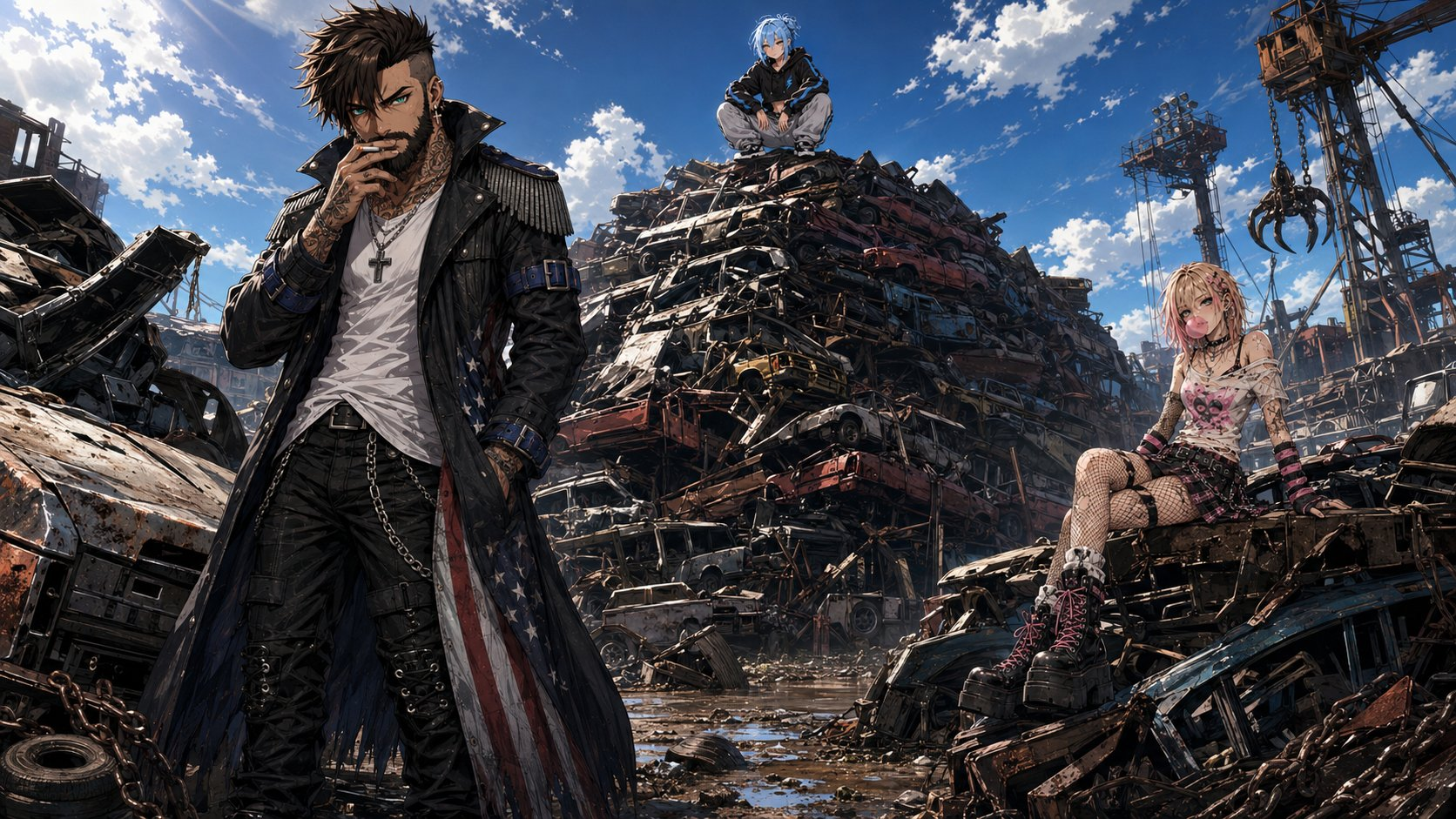
Three characters. Three levels. One towering scrapyard.
Build a cinematic industrial scene around a mountain of crushed cars. Place one character close on the left, one squatting at the central summit, and one seated on a lower stack to the right, all rendered in detailed semi-realistic anime with heavy cel shading.
GET THE PROMPT ↓THE FINISHED LOOK
01 EXAMPLEA foreground anchor, a summit silhouette, and a seated figure form a triangular composition across the scrapyard. Select the image to view the original at full size.
BEFORE YOU CREATE
LABEL YOUR THREE CHARACTER SHEETS.
- Character Sheet A — left foreground. This character is closest to the camera and forms the largest foreground presence.
- Character Sheet B — center summit. This character performs a deep resting squat atop the tallest crushed-car pile.
- Character Sheet C — seated at right. This character sits on the edge of a much lower vehicle stack.
- Copy the complete prompt. Paste it alongside all three labeled sheets. The written prompt defines the setting, camera, and staging; no separate composition reference is required.
THE COMPLETE PROMPT
ORIGINAL TEMPLATEYour supplied wording is preserved in full, including the character assignments and failure prevention instructions.
Read the complete prompt
MASTER IMAGE-GENERATION PROMPT — THREE-CHARACTER JUNKYARD / CRUSHED-CAR PYRAMID / CHARACTER-SHEET LOCK

Use the supplied THREE CHARACTER SHEETS as the absolute and only visual authority for the three characters.

Create ONE highly polished, cinematic, ultra-detailed semi-realistic anime illustration of three characters posed throughout a sprawling industrial junkyard filled with crushed cars, rusted machinery, scrap metal, tires, wreckage, and towering vehicle piles.

There is NO separate composition reference image.

The complete composition, camera, staging, poses, environment, scale, depth, lighting, and overall presentation are defined entirely by this prompt.

The final artwork should resemble premium anime key art, graphic-novel splash art, AAA game promotional artwork, or highly detailed dystopian concept art.

⸻

CORE PRIORITY

CHARACTER IDENTITIES = LOCKED TO THEIR RESPECTIVE CHARACTER SHEETS

ENVIRONMENT / COMPOSITION / CAMERA / CHARACTER PLACEMENT / GENERAL POSES = LOCKED TO THIS PROMPT

Follow this hierarchy:

LOCK CHARACTER A
→ LOCK CHARACTER B
→ LOCK CHARACTER C
→ BUILD THE JUNKYARD
→ ESTABLISH THE THREE-LEVEL COMPOSITION
→ PLACE EACH CHARACTER IN THEIR ASSIGNED POSITION
→ APPLY CINEMATIC LIGHTING
→ APPLY HEAVY CEL SHADING
→ FINAL CHARACTER-IDENTITY CHECK

Never sacrifice character accuracy for composition or style.

⸻

CHARACTER ASSIGNMENT — ABSOLUTE

The three supplied character sheets correspond to the following positions:

CHARACTER SHEET A

LEFT FOREGROUND CHARACTER

This character must appear closest to the camera on the left side of the composition.

CHARACTER SHEET B

CENTER / HIGHEST-PILE CHARACTER

This character must appear at the top center of the composition, positioned on the summit of the tallest crushed-car pile.

CHARACTER SHEET C

RIGHT / SEATED CHARACTER

This character must appear on the right side of the composition, sitting casually on the edge of a lower pile of crushed vehicles.

Do not exchange, rearrange, merge, or confuse the three characters.

⸻

CHARACTER-SHEET LOCK

For ALL THREE CHARACTERS, preserve everything established by their individual character sheets.

This includes, whenever visible:

* exact facial structure
* apparent age
* biological presentation
* body type
* height relationships where reasonably inferable
* skin tone
* eye color
* eye shape
* eyebrows
* nose
* mouth
* hairstyle
* hair length
* hair color
* bangs
* facial hair
* scars
* tattoos
* piercings
* makeup
* cybernetics
* prosthetics
* horns
* ears
* tails
* wings
* supernatural traits
* clothing
* armor
* footwear
* jewelry
* necklaces
* chains
* gloves
* belts
* accessories
* symbols
* weapons if part of the established design
* distinctive silhouette
* established color palette

The character sheets override generic anime conventions.

Do NOT beautify, simplify, sanitize, redesign, age up, age down, feminize, masculinize, recolor, restyle, or replace recognizable character features.

Do not invent substitute clothing when the supplied outfit can reasonably perform the required pose.

Adapt fabric folds, coat position, accessories, hair movement, and clothing tension naturally to each pose while preserving the actual design.

⸻

FINAL COMPOSITION

Create a wide cinematic landscape composition, approximately 16:9.

The image contains three distinct visual levels:

1. Character A — large foreground presence on the left
2. Character B — small but dominant high silhouette at center
3. Character C — medium-distance seated figure on the right

The environment should naturally lead the viewer’s eye:

Character A
→ central car mountain
→ Character B at the summit
→ Character C on the right

Avoid arranging the characters in a straight horizontal lineup.

The composition should feel dimensional, asymmetric, and naturally photographed rather than staged like a character-selection screen.

⸻

CAMERA

Use a wide cinematic lens, approximately equivalent to 24–30 mm.

Camera height should be roughly chest-to-waist height relative to a standing adult.

Use a subtle low-angle perspective so the central vehicle pile feels imposing.

Character A is considerably closer to the camera and therefore appears physically larger within the frame.

Character B is furthest vertically from the viewer and appears smaller because they are standing high above the junkyard.

Character C occupies the middle distance.

Maintain convincing perspective and scale.

Avoid extreme fisheye distortion.

⸻

ENVIRONMENT — MASSIVE JUNKYARD

The entire scene takes place inside a sprawling industrial automobile scrapyard.

Fill the environment with:

* crushed cars
* flattened automobiles
* wrecked sedans
* old coupes
* broken pickup trucks
* mangled vehicle frames
* exposed engines
* shattered headlights
* dented doors
* rusted bumpers
* loose tires
* wheels
* twisted sheet metal
* scrap beams
* suspension parts
* chains
* broken glass
* oily puddles
* mud
* dust
* rust flakes
* scattered mechanical debris
* industrial fencing
* distant scrap heaps
* utility structures
* smokestacks
* floodlight towers
* cranes
* scrapyard machinery

The cars should look physically crushed and stacked rather than simply parked on top of one another.

Include visible deformation:

* flattened roofs
* compressed cabins
* warped panels
* crushed doors
* broken windows
* bent frames
* exposed interiors
* twisted axles
* oxidized paint

Use many different vehicle colors, but most should be faded, scratched, dirty, sun-bleached, or rusted.

The junkyard must feel huge and believable.

⸻

CENTRAL VEHICLE MOUNTAIN

The primary environmental landmark is a massive pyramid-like pile of crushed cars occupying the center of the image.

This must be the highest pile anywhere in the junkyard.

Build it from many visibly separate wrecked vehicles stacked irregularly on top of one another.

The pile should be broad at the bottom and progressively narrower toward the top.

It should resemble a mountain, throne, or artificial scrapyard monument.

Do not make it a neat cube.

Do not make the pile geometrically perfect.

It should feel unstable, organic, chaotic, and extremely heavy.

The viewer should immediately understand that this is the dominant structure in the scene.

⸻

CHARACTER B — CENTER SUMMIT

Place CHARACTER B on the very top of the central vehicle mountain.

Character B is performing a recognizable Slav squat / deep resting squat.

Pose requirements:

* feet planted apart
* heels down if anatomically compatible
* knees deeply bent
* hips low
* torso upright or slightly leaned forward
* arms resting loosely around the knees
* elbows may rest near the thighs
* hands relaxed
* balanced naturally
* confident posture

The pose should feel effortless rather than athletic.

Character B should look completely comfortable balancing on top of the crushed vehicle pile.

Do not turn this into:

* kneeling
* sitting
* crouching on one knee
* superhero landing
* combat stance
* perched gargoyle pose

The silhouette should clearly read as a deep squat.

Character B should occupy a relatively small amount of the total image but remain visually important because of their elevated position.

Give Character B a strong readable silhouette against the sky.

⸻

CHARACTER A — LEFT FOREGROUND

Place CHARACTER A in the left foreground, significantly closer to the camera than the other two characters.

Character A should occupy roughly the left quarter to left third of the image.

They should appear approximately from mid-thigh, knee, or upper-leg level upward depending on natural framing.

Give Character A a relaxed, natural pose appropriate to their personality and clothing.

Examples of acceptable body language include:

* casually standing
* slight lean against wreckage
* one shoulder lowered
* weight shifted onto one leg
* hand resting near a pocket
* one hand hanging naturally
* slight hip shift
* relaxed crossed ankle
* casual interaction with a nearby scrap surface

Do not make Character A perform an exaggerated action.

Character A should feel as if the camera caught them naturally standing in the scrapyard.

Their pose should communicate confidence, attitude, or personality without appearing like a rigid fashion mannequin.

Preserve all costume and character-sheet details.

Use Character A as the strongest foreground anchor.

Allow some foreground debris to partially frame them without covering important identity features.

⸻

CHARACTER C — RIGHT VEHICLE STACK

On the right side of the image, create another pile of crushed vehicles.

This pile should be dramatically lower than the central mountain.

Its upper seating surface should sit approximately a little above the waist height of a standing adult, roughly equivalent to a stack of one heavily crushed car plus additional wreckage.

It should NOT rival the height of the central vehicle mountain.

Place CHARACTER C sitting naturally on the outer edge of this vehicle stack.

Character C should be elevated above the ground but remain clearly below Character B.

⸻

CHARACTER C — SEATED POSE

Character C sits casually on the edge of the right-side pile.

The pose should feel informal and natural.

Possible leg placement:

* both legs hanging over the edge
* one foot resting against lower wreckage
* one knee slightly higher than the other
* one leg bent while the other hangs
* feet resting against a lower crushed vehicle

Possible arm placement:

* hands resting between the knees
* one hand braced behind the body
* elbows resting loosely on thighs
* one forearm across a knee
* hands hanging casually

Character C should look comfortable rather than stiff.

Avoid:

* formal chair posture
* cross-legged meditation pose
* dramatic combat stance
* superhero pose
* perfect symmetry

Their clothing must react naturally to gravity and the seated posture.

⸻

SPATIAL RELATIONSHIP

The three characters should form an implied triangular composition.

LEFT

Character A — closest and largest.

TOP CENTER

Character B — smallest in scale but highest in elevation.

RIGHT

Character C — middle distance and middle scale.

This triangular arrangement is essential.

Do not place all three characters at the same distance from the camera.

Do not put all three at ground level.

Do not center all three faces at the same vertical height.

⸻

FOREGROUND DETAIL

Include heavy foreground detail around Character A and across the bottom edge of the composition.

Possible elements:

* rusted car panel
* bent hood
* crushed door
* exposed wheel
* broken grille
* loose tire
* industrial barrel
* metal beam
* chain
* puddle
* cracked concrete
* twisted wire
* scattered bolts

Use foreground objects to strengthen depth.

Some objects may be slightly cropped by the image edges.

⸻

RIGHT-SIDE INDUSTRIAL DETAIL

Behind and around Character C, add additional junkyard machinery.

Possible elements include:

* hydraulic crane
* magnetic lifting crane
* mechanical scrap claw
* excavator arm
* rusted gantry
* floodlight pole
* stacked vehicle shells

A large mechanical claw hanging somewhere in the upper-right background is encouraged.

It should add industrial atmosphere without distracting from Character C.

⸻

BACKGROUND

Beyond the foreground piles, show a larger scrapyard stretching into the distance.

Include:

* more stacks of vehicles
* industrial towers
* distant cranes
* scrap-processing equipment
* fencing
* power structures
* warehouses
* smokestacks
* haze

Keep distant details slightly softer than the primary characters and major vehicle piles.

Maintain strong atmospheric depth.

⸻

SKY

Use a large, dramatic sky occupying a meaningful portion of the upper frame.

Preferred atmosphere:

* rich blue sky
* large sculptural white clouds
* bright daylight
* scattered cloud shadow

The clean open sky should contrast against the dirty scrapyard below.

Character B should partially silhouette against this sky.

⸻

LIGHTING

Use dramatic natural daylight.

Primary light:

strong directional sunlight from the upper-left or upper-front-left

Create:

* bright rim highlights
* illuminated hair edges
* sharply defined cast shadows
* reflective highlights on metal
* bright sky illumination
* deep shadow pockets beneath vehicles
* dramatic contrast between sun and shade

Characters should be clearly readable against the busy environment.

Do not flatten the scene with evenly distributed lighting.

⸻

ART STYLE

Render the scene in an:

ULTRA-DETAILED SEMI-REALISTIC ANIME / GRAPHIC-NOVEL STYLE WITH HEAVY CEL SHADING

The artwork should combine:

* realistic anatomy
* anime facial construction
* sophisticated anime character rendering
* crisp linework
* premium illustration quality
* detailed industrial textures
* hard-edged shadows
* strong graphic shadow shapes
* layered cel shading
* painterly texture accents
* realistic metal reflections
* controlled material rendering
* cinematic color grading
* strong depth
* high visual clarity

Use heavy cel shading, not soft airbrushed anime shading.

Shadow boundaries should often be deliberate and graphic.

Use multiple cel-shaded value bands where useful.

Retain enough painterly texture that the image feels premium and semi-realistic rather than flat television animation.

⸻

MATERIAL DETAIL

Cars and machinery require extremely detailed material rendering.

Show:

METAL

* oxidized steel
* scratches
* chipped paint
* bare metal
* rust
* dents
* grime

GLASS

* shattered windows
* fractured windshields
* reflective fragments

RUBBER

* dirty tires
* worn tread
* torn sidewalls

GROUND

* cracked concrete
* packed dirt
* oil stains
* mud
* small puddles
* metal fragments

CLOTHING

Preserve the fabrics and materials established in each respective character sheet.

Render fabric folds according to gravity and body position.

⸻

CHARACTER RENDERING

Characters should receive slightly cleaner visual treatment than the junkyard so they remain readable.

Use:

* crisp facial detail
* controlled highlights
* clear eye rendering
* accurate hair shapes
* strong silhouette separation
* layered cel shadows
* subtle reflected environmental light

Do not allow environmental complexity to obscure the faces.

⸻

EXPRESSION

Use expressions appropriate to each character’s established design and personality when evident from the sheets.

In the absence of a clearly defined expression:

CHARACTER A

Relaxed, self-assured, mildly intimidating, indifferent, or cool.

CHARACTER B

Confident, calm, slightly defiant, observant.

CHARACTER C

Casual, relaxed, bored, thoughtful, or quietly confident.

Avoid exaggerated comedy unless the character sheet explicitly supports it.

⸻

COLOR PALETTE

Overall environment:

* rust orange
* dark brown
* faded red
* dusty blue
* dirty gray
* oxidized steel
* black
* muted industrial tones

Sky:

* rich blue
* bright white clouds

Character colors remain exactly governed by their respective character sheets.

Do not recolor the characters simply to match the junkyard palette.

⸻

DEPTH OF FIELD

Use subtle cinematic depth separation.

Character A:
extremely sharp

Character B:
sharp enough for clear character recognition

Character C:
sharp

Immediate environment:
high detail

Distant scrapyard:
slightly softened through atmospheric perspective

Do not use excessive portrait-style background blur.

The junkyard itself is an important visual subject.

⸻

VISUAL DENSITY

The image should reward close inspection.

Include many small believable details such as:

* bolts
* cables
* hanging chains
* exposed wiring
* cracked lights
* license-plate fragments
* seat frames
* steering wheels
* exhaust pipes
* suspension components
* scraps of painted metal
* bent chrome
* scattered tools
* puddle reflections
* oil streaks

However, maintain clean compositional hierarchy.

The characters must never become visually lost.

⸻

MOOD

The image should feel:

* gritty
* rebellious
* stylish
* cinematic
* industrial
* youthful
* dangerous without active violence
* post-industrial
* slightly dystopian
* effortlessly cool

The characters should feel like they belong in this environment rather than appearing pasted into it.

⸻

REQUIRED FINAL READ

At first glance, the viewer should immediately understand:

A THREE-PERSON CREW OCCUPYING A MASSIVE JUNKYARD

with:

ONE CHARACTER CLOSE ON THE LEFT

ONE CHARACTER SQUATTING ON TOP OF A HUGE CENTRAL MOUNTAIN OF CRUSHED CARS

and

ONE CHARACTER SITTING ON A LOWER VEHICLE STACK ON THE RIGHT

The central crushed-car mountain must remain the dominant environmental structure.

⸻

ABSOLUTE DO-NOT-CHANGE RULES

Do NOT:

* swap the characters’ positions
* merge character designs
* mix clothing between sheets
* invent alternate faces
* replace hairstyles
* alter skin tones
* change established body types
* change signature accessories
* remove major character-defining features
* make Character B stand instead of squat
* make Character B sit
* make Character C stand
* put Character C on the ground
* place Character A in the background
* make the right pile taller than the central pile
* make the environment clean
* use intact showroom-quality cars
* make the vehicles uniformly arranged
* create a flat character lineup
* use soft pastel anime rendering
* use chibi proportions
* use cartoonishly exaggerated anatomy
* use photorealism
* obscure the characters’ faces
* add random extra characters

⸻

NEGATIVE PROMPT / FAILURE PREVENTION

Avoid:

wrong character assignments, character fusion, duplicated characters, extra people, incorrect hair, incorrect costume, missing accessories, simplified character design, face drift, generic anime faces, beautification, altered age, altered body type, bad anatomy, extra fingers, missing fingers, fused limbs, broken joints, duplicate limbs, floating objects, impossible vehicle stacking, clean cars, pristine scrapyard, symmetrical composition, lineup composition, all characters standing, all characters sitting, central character standing, right character standing, foreground character too small, central pile too short, excessive blur, fisheye distortion, washed-out lighting, muddy shadows, flat shading, soft airbrush shading, 3D-render appearance, plastic skin, photorealism, low environmental detail, empty background, text, captions, signatures, borders, logos, watermarks.

⸻

FINAL QUALITY TARGET

The completed image should look like a premium professionally illustrated anime key visual featuring the three supplied characters inside a vast, highly detailed junkyard.

It should combine:

CHARACTER-SHEET-ACCURATE DESIGNS

STRONG THREE-LEVEL CINEMATIC COMPOSITION

TOWERING CENTRAL CRUSHED-CAR PYRAMID

NATURAL CHARACTER BODY LANGUAGE

ULTRA-DETAILED INDUSTRIAL ENVIRONMENT

HEAVY GRAPHIC CEL SHADING

SEMI-REALISTIC ANIME RENDERING

CINEMATIC 16:9 PRESENTATION

The three character sheets are the absolute authority for identity.

The written prompt is the absolute authority for composition.