IMAGE CREATION / CINEMATIC ACTION
SHADOW
ASCENSION.
A silhouette. A spirit. A world transformed.
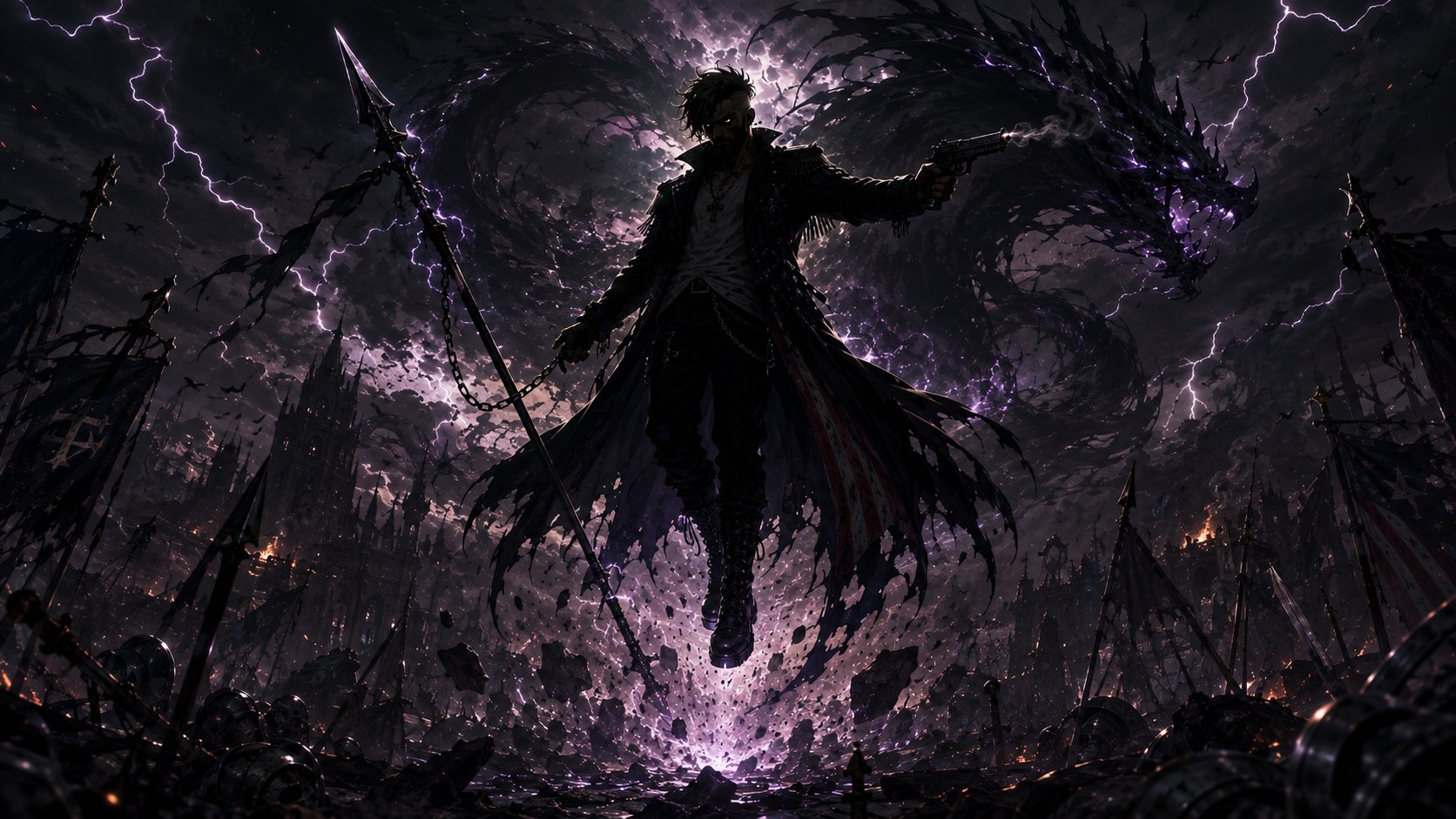
Elevate your character above a devastated supernatural battlefield, joined by a unique personal spirit creature. Combat style, weapon, aura, and environment emerge from the character’s own identity.
GET THE PROMPT ↓THE FINISHED LOOK
01 EXAMPLEA dark, levitating character framed by supernatural power and a monumental spirit creature. Select the image to view the original at full size.
BEFORE YOU CREATE
LET THE CHARACTER SHAPE THE WORLD.
- Attach a character sheet. Supply the character sheet as the visual authority for identity, clothing, anatomy, and signature features.
- Copy the full prompt. Paste it into your image generation chat with the sheet. The master prompt derives combat identity, a signature weapon or fighting method, and a unique spirit from the character.
- Create the cinematic frame. The prompt calls for a 16:9 battlefield scene, a readable dark silhouette, levitation, and a fully formed spirit creature.
THE COMPLETE PROMPT
ORIGINAL TEMPLATECopy the complete prompt and supply your character sheet. The wording below is preserved, with paragraph breaks for readability.
Read the complete prompt
MASTER IMAGE-GENERATION PROMPT — SHADOW ASCENSION / LEVITATING SPIRIT BATTLEFIELD / CHARACTER-DERIVED SIGNATURE WEAPON

Use the supplied CHARACTER SHEET as the absolute and only visual authority for the character.

Create ONE epic, highly polished, cinematic, semi-realistic anime illustration in a 16:9 widescreen composition featuring the exact character from the supplied CHARACTER SHEET as a predominantly dark silhouette, levitating above a devastated supernatural battlefield alongside their unique personal spirit creature and using a character-derived signature weapon or combat method.

The finished image should feel like a premium anime movie key visual:

dark, monumental, supernatural, elegant, apocalyptic, atmospheric, powerful, highly detailed, dramatically illuminated, and unmistakably specific to the character.

⸻

CORE CREATIVE HIERARCHY

CHARACTER IDENTITY = LOCKED.

COMBAT IDENTITY, SIGNATURE WEAPON, SPIRIT CREATURE, POSE, CAMERA, WORLD, MAGIC, WEATHER, AND BATTLEFIELD INTERACTION = CHARACTER-DERIVED AND CREATIVE.

Follow this order:

LOCK CHARACTER
→ ANALYZE CHARACTER
→ DETERMINE COMBAT IDENTITY
→ CREATE SIGNATURE WEAPON / COMBAT METHOD
→ CREATE UNIQUE SPIRIT
→ DESIGN CHARACTER-SPECIFIC FIGHTING POSE
→ CHOOSE CINEMATIC CAMERA
→ DERIVE AURA / MAGIC
→ BUILD PERSONAL BATTLEFIELD REALM
→ APPLY CINEMATIC LIGHTING AND ATMOSPHERE

Never reverse this hierarchy.

The weapon, spirit, pose, aura, and environment must emerge from the character rather than forcing the character into a generic fantasy archetype.

⸻

1. CHARACTER FIDELITY — ABSOLUTE HIGHEST PRIORITY

Treat the CHARACTER SHEET as an exact visual blueprint.

Preserve exactly:

* apparent adult age
* face shape and facial structure
* eye shape
* exact eye color
* pupils
* unusual eye traits
* eyebrows
* hairstyle
* hair length
* hair texture
* hair volume
* exact hair colors, streaks, gradients, and placement
* skin tone or body coloration
* body type
* build
* height impression
* anatomy
* proportions
* species
* gender presentation
* ears
* horns
* tails
* wings
* claws
* supernatural or non-human anatomy
* scars
* tattoos
* freckles
* markings
* piercings
* clothing
* armor
* jewelry
* accessories
* eyewear
* symbols
* signature objects
* distinctive shapes
* established visual personality

Do not redesign, reinterpret, simplify, genericize, beautify, exaggerate, approximate, or replace the character.

Do not alter:

* body shape
* proportions
* hairstyle
* species
* anatomy
* clothing silhouette
* accessories
* signature features

Do not borrow traits from another character.

Do not add wings, horns, tails, ears, clothing, armor, anatomical features, or accessories that are not established by the CHARACTER SHEET.

The character must remain recognizable from the outer silhouette alone.

The CHARACTER SHEET overrides every generic suggestion in this prompt.

⸻

2. SILHOUETTE PRESENTATION

The character must be rendered predominantly as a SOLID BLACK / EXTREMELY DARK SILHOUETTE.

The overall character presentation should remain dramatically dark.

Do not reveal normal internal rendering of:

* face
* skin
* clothing textures
* armor materials
* body surface detail

Use only controlled visual information such as:

* subtle rim lighting
* aura edge light
* reflected magical light
* backlighting
* extremely restrained hints of established eye glow if absolutely necessary for character identity

The internal body mass should remain overwhelmingly dark.

Lighting should primarily describe the contour, not illuminate the entire character.

Hair, clothing, accessories, limbs, weapon, and anatomy should remain clearly readable through silhouette separation.

Magic, particles, smoke, wind, and environmental effects must never obscure or deform the silhouette.

The character must remain visually recognizable and structurally readable at a glance.

⸻

3. CHARACTER INTERPRETATION — BEFORE COMBAT DESIGN

Before creating the weapon, spirit, pose, or magic, visually analyze the character’s:

* personality
* emotional energy
* temperament
* confidence
* aggression or restraint
* elegance or brutality
* discipline or recklessness
* intelligence or instinctiveness
* supernatural nature
* physicality
* aesthetic
* clothing
* species
* symbolism
* cultural influences
* visual motifs
* occupation
* archetype
* technological level
* religious imagery
* occult imagery
* celestial imagery
* infernal imagery
* natural motifs
* personal objects
* narrative presence

Infer how THIS specific character would naturally approach combat.

Consider:

* preferred combat distance
* offensive vs defensive behavior
* speed vs power
* precision vs overwhelming force
* physical vs magical combat
* conventional vs unconventional fighting
* strategic vs instinctive behavior
* controlled vs chaotic combat
* relationship with violence

Determine the character’s combat identity FIRST.

Choose the weapon SECOND.

The weapon must emerge from the character.

⸻

4. SIGNATURE WEAPON / COMBAT METHOD — CHARACTER-DERIVED

Equip the character with ONE primary signature weapon, weapon system, supernatural combat implement, or character-appropriate fighting method.

If the CHARACTER SHEET visibly establishes a specific weapon, preserve it with extremely high fidelity.

If no weapon is established, create one specifically for the character based on their inferred combat identity.

This is the ONLY exception to the general rule against adding unestablished equipment:

A signature weapon may be newly created when none exists on the sheet, but it must feel like a natural extension of the character rather than a redesign of them.

The weapon should make the viewer instinctively think:

“Of course this character would use that.”

Never:

“This is simply the weapon the generator gives everyone.”

⸻

5. WEAPON SELECTION — FULL CONCEPTUAL RANGE

Choose freely from the full range of combat archetypes.

Do not favor swords, firearms, or any other common category by default.

Possible categories include:

BLADED

* longsword
* greatsword
* saber
* rapier
* katana
* cleaver
* dagger
* kukri
* twin blades
* oversized fantasy blade
* ritual blade

POLEARMS

* spear
* glaive
* halberd
* naginata
* trident
* lance
* poleaxe
* war scythe

HEAVY / IMPACT

* battle axe
* great axe
* war hammer
* maul
* mace
* flail
* massive club
* crushing gauntlet

FLEXIBLE / UNCONVENTIONAL

* chains
* chained blades
* whip
* rope dart
* kusarigama
* segmented weapon
* hooked weapon

RANGED

* bow
* longbow
* crossbow
* throwing weapons
* supernatural projectiles

MAGICAL / OCCULT

* staff
* wand
* scepter
* grimoire
* relic
* ritual object
* enchanted lantern
* floating runes
* summoned weapons
* spectral constructs
* elemental weapons
* cursed artifact
* holy artifact

UNARMED / BODY-BASED

* armored gauntlets
* claws
* transformed limbs
* supernatural fists
* talons
* energy-coated hands
* martial arts
* monstrous anatomy

TECHNOLOGICAL

* energy blade
* powered weapon
* mechanical weapon
* powered gauntlet
* rail weapon
* transforming weapon
* drone-controlled weapon
* engineered hybrid weapon

PERSONALIZED / HYBRID

* musical instrument adapted into a weapon
* occupational tool adapted into a weapon
* ceremonial object adapted into a weapon
* unusual improvised weapon
* symbolic artifact
* character-specific hybrid weapon
* motif-driven supernatural weapon

FIREARMS

* pistol
* revolver
* rifle
* shotgun
* sniper weapon
* specialized futuristic firearm

Firearms belong only to one possible category and receive NO preferential treatment.

Do not automatically select:

* pistols
* dual pistols
* guns
* swords
* paired weapons

A free hand is completely acceptable.

A two-handed weapon is completely acceptable.

One weapon with the opposite hand free is completely acceptable.

A floating weapon is acceptable.

A magically controlled weapon is acceptable.

A body-integrated weapon is acceptable.

A magical focus is acceptable.

Unarmed supernatural combat is acceptable.

The character does NOT need to hold an object in both hands.

⸻

6. WEAPON PERSONALITY LOGIC

Use personality as an influence rather than a rigid template.

Examples:

A massive brutal character might favor a huge axe, maul, hammer, great blade, heavy polearm, or supernatural strength.

A disciplined or precise character might favor a spear, rapier, bow, controlled blade, or technical polearm.

An elegant character might favor a saber, rapier, ornate polearm, ritual focus, or refined supernatural weapon.

A rebellious or reckless character might use chains, an improvised weapon, oversized blade, or unconventional hybrid.

A quiet supernatural character might wield spectral constructs, shadows, summoned blades, or no conventional weapon.

An occult character might use a grimoire, relic, ritual blade, staff, chains, runes, or summoned entity.

A beastlike character might fight through claws, transformed anatomy, brute force, or a weapon adapted to their physiology.

A technological character might use a mechanical, powered, transforming, or energy-based system.

An artist, musician, or performer might wield a combat method derived from their creative identity.

A knightly protector might favor a sword and shield, polearm, mace, or greatsword.

A hunter might favor bows, spears, crossbows, traps, or hunting implements.

A clearly firearm-oriented soldier, detective, outlaw, gunslinger, mercenary, or operative may appropriately use firearms.

These are possibilities, not templates.

Character compatibility always wins.

⸻

7. WEAPON DESIGN LANGUAGE

The signature weapon must inherit visual language already present in the character.

It may incorporate established elements such as:

* character colors
* religious symbolism
* occult motifs
* celestial motifs
* infernal motifs
* natural materials
* elemental themes
* musical themes
* cultural influences
* royal imagery
* industrial motifs
* gothic elements
* streetwear influences
* military influences
* personal symbols
* jewelry shapes
* tattoos
* markings
* supernatural anatomy
* technological details

Do not add random motifs unsupported by the character.

The weapon should appear as though it has always belonged to them.

Favor a memorable, readable silhouette.

Weapon scale may vary dramatically.

The appropriate choice may be:

* one enormous weapon
* one medium weapon
* one precision weapon
* a two-handed weapon
* weapon and shield
* weapon plus free hand
* paired melee weapons
* floating weapon
* multiple summoned constructs
* body-integrated weapon
* supernatural anatomy
* magical focus
* unconventional hybrid

Paired weapons should only appear when they meaningfully reinforce the character’s identity.

⸻

8. PERSONAL SPIRIT CREATURE

After understanding the character, create ONE unique personal spirit creature specifically for them.

The spirit should feel like:

“THIS CHARACTER’S SOUL GIVEN PHYSICAL FORM.”

Do not begin with a familiar creature and merely recolor it.

Do not reuse a creature from another character.

Do not copy a reference creature.

The spirit may be:

* real
* mythical
* hybrid
* elemental
* celestial
* infernal
* spectral
* technological
* abstractly inspired but anatomically concrete
* entirely original

Derive the spirit’s:

* species concept
* anatomy
* silhouette
* scale
* coloration
* markings
* materials
* temperament
* locomotion
* behavior
* aura
* magic
* symbolism
* relationship to the character

from THIS character’s specific visual and emotional DNA.

The spirit should complement the signature weapon and combat identity without simply becoming another weapon.

⸻

9. SPIRIT ANATOMY — STRICT RULE

The spirit must ALWAYS be a complete, recognizable, fully formed creature.

It must have coherent connected anatomy.

Where appropriate, clearly establish:

* head
* torso/body
* limbs or locomotion structures
* neck
* tail
* wings
* fins
* horns
* antlers
* claws
* other species-specific structures

Use believable:

* joints
* anatomy
* proportions
* perspective
* structural continuity
* locomotion logic

Original or hybrid creatures must still follow one unified anatomical system.

Never create:

* energy blobs
* vague animal-shaped smoke
* fragmented creatures
* disconnected anatomy
* random collections of body parts
* floating heads
* malformed hybrids
* duplicated limbs
* impossible joints
* ambiguous creatures

The spirit must read as a deliberate creature design, not an accidental magical shape.

⸻

10. CHARACTER / SPIRIT RELATIONSHIP

The spirit should actively participate in the composition.

It may:

* coil around the character’s vertical space
* descend from behind
* rise from battlefield smoke
* hover protectively overhead
* circle the character
* mirror the character’s attack direction
* roar toward the enemy
* guard the character
* emerge from their aura
* interact visually with the signature weapon

Use flowing movement to create a visual connection between:

CHARACTER → WEAPON → AURA → SPIRIT → ENVIRONMENT

The spirit should feel bonded to the character, not like an unrelated monster standing nearby.

⸻

11. CORE COMPOSITION

Use a dramatic 16:9 widescreen cinematic composition.

Place the character levitating several feet above the center region of the battlefield.

The character should remain the primary foreground focal point, preferably with subtle asymmetry rather than rigid geometric centering.

Use a powerful frontal, three-quarter, or slightly low-angle hero perspective.

The viewer should feel as though they are looking upward at an overwhelmingly powerful supernatural figure.

Use full-body or nearly full-body framing.

Create strong spatial depth:

FOREGROUND DEBRIS
→ CHARACTER
→ SIGNATURE WEAPON / AURA
→ SPIRIT
→ DISTANT BATTLEFIELD / SKY

Use:

* controlled foreshortening
* sweeping leading lines
* atmospheric perspective
* dramatic scale
* strong silhouette separation

Avoid:

* flat eye-level presentation
* mannequin posing
* passport framing
* ordinary standing
* symmetrical stiffness
* weak depth

⸻

12. LEVITATING FIGHTING POSE

The character must be levitating in a strong, deliberate, battle-ready pose.

Design the pose only AFTER selecting the character’s combat archetype and weapon.

The stance must communicate how THIS specific character actually fights.

Possible actions include:

* preparing to strike
* raising a weapon for a finishing blow
* holding a defensive guard
* aiming a ranged weapon
* channeling supernatural power
* preparing a charge
* calmly confronting an enemy
* casting a spell
* manipulating a floating weapon
* controlling summoned constructs
* fighting through supernatural anatomy
* recovering between attacks
* commanding the spirit creature

Examples are conceptual only:

A greatsword wielder may carry the weapon with deliberate weight.

A spear user may create a long aggressive directional silhouette.

A mage may control a magical focus with one hand while channeling power with the other.

A chain fighter may create sweeping arcs through the composition.

An unarmed supernatural character may use a compact martial stance surrounded by concentrated energy.

A firearm user may aim, shoulder, carry, or draw the weapon according to their actual archetype.

Do not default firearm characters to akimbo dual-wielding.

The pose must feel:

* controlled
* powerful
* dangerous
* anatomically believable
* visually elegant
* character-specific

Keep clear limb separation.

If hands are visible, render anatomically correct hands with exactly five fingers per hand.

⸻

13. HAIR, CLOTHING & MOTION

Allow existing loose elements to react naturally to levitation, wind, aura pressure, and combat movement.

This may include:

* hair
* coats
* ribbons
* straps
* skirts
* tails
* wings
* fur
* feathers
* loose fabric

Movement should radiate naturally outward or upward from the character.

Preserve the original silhouette and design.

Do not invent:

* capes
* robes
* scarves
* giant flowing coats
* ribbons
* cloth extensions

unless they exist on the CHARACTER SHEET.

Motion must enhance readability rather than distort the character.

⸻

14. CHARACTER-SPECIFIC AURA

Generate supernatural power pouring outward from the character and, where appropriate, through their weapon.

Derive the aura from:

* character colors
* eye color
* species
* supernatural traits
* personality
* emotional tone
* clothing palette
* symbols
* motifs
* combat archetype
* signature weapon
* spirit creature

Do NOT default every character to golden flames or generic blue energy.

Possible manifestations include:

* flame
* lightning
* plasma
* smoke
* magical mist
* living shadow
* celestial light
* spectral energy
* glowing runes
* corrupted static
* feathers
* embers
* frost
* crystal fragments
* petals
* arcane ribbons
* void energy
* distorted space
* supernatural wind
* fragments of light
* ink-like darkness
* geometric energy
* sparks
* particles
* energy rings
* arcs
* spirals
* waves

The aura must remain uniquely connected to THIS character.

It should reinforce the silhouette rather than erase it.

⸻

15. PRIMARY LIGHT SOURCE — CHARACTER POWER

The character’s supernatural aura and magical presence must act as the principal light source for the scene.

Because the character remains predominantly a dark silhouette, the light should illuminate primarily:

* silhouette edges
* weapon edges
* hair contours
* clothing contours
* spirit creature surfaces
* smoke
* dust
* nearby rubble
* broken weapons
* battlefield terrain beneath the character

The aura must NOT flood the character’s internal silhouette with light.

Use believable light falloff.

Nearby battlefield objects receive stronger illumination.

Distant terrain fades gradually into darkness and haze.

⸻

16. SECONDARY RIM LIGHT

Add subtle secondary backlight or side rim lighting.

It should:

* separate the silhouette from the battlefield
* sharpen the weapon outline
* define hair edges
* define clothing edges
* enhance non-human anatomy
* create strong anime-style edge highlights
* deepen opposite-side shadows

The secondary light must remain weaker than the character’s supernatural light source.

⸻

17. CEL-SHADED DARKNESS

Use dramatic semi-realistic anime rendering with strong cel-shaded shadow structure.

Create:

* deep shadow planes
* crisp boundaries
* bold shape separation
* controlled reflected light
* strong silhouette contrast
* sharp fabric and weapon shadow shapes
* realistic anatomy underneath stylized anime rendering

Avoid:

* flat lighting
* evenly distributed studio light
* excessive ambient fill
* washed-out shadows

The character should feel carved out of darkness by supernatural light.

⸻

18. PERSONAL BATTLEFIELD REALM

Place the character over a vast devastated battlefield, but derive the environmental character from their symbolism and aesthetic.

The battlefield may contain:

* broken earth
* craters
* shattered stone
* damaged armor
* abandoned weapons
* broken banners
* splintered poles
* destroyed structures
* ruined monuments
* distant fires
* smoke
* ash
* dust
* debris
* supernatural weather
* magical contamination
* character-specific environmental phenomena

The battlefield must remain:

* dark
* subdued
* desaturated
* lower contrast than the character

Foreground debris may be sharp and detailed.

Distant destruction should progressively dissolve into:

* haze
* smoke
* shadow
* atmospheric perspective

The environment should feel enormous but never compete with the character.

⸻

19. GROUND INTERACTION

Directly below the levitating character, show visible interaction between their power and the battlefield.

Depending on the character, weapon, spirit, and aura, this may include:

* glowing cracks
* displaced dust
* rising stones
* scorched earth
* frost
* sparks
* shadow tendrils
* magical markings
* rippling pressure waves
* floating debris
* fractured ground
* illuminated smoke
* distorted space
* weapon-generated energy damage
* character-specific supernatural effects

Do not automatically add a circular magical glyph.

Only use one if it genuinely belongs to the character.

⸻

20. SKY / WEATHER / ATMOSPHERE

Use a dramatic dark exterior battlefield sky.

The atmosphere may include:

* massive storm clouds
* lightning
* distant smoke columns
* drifting ash
* dust
* rain
* supernatural storms
* celestial breaks in cloud cover
* faint distant fires
* character-derived magical weather

Keep background values subdued and strategically controlled.

Avoid bright generic skies.

Avoid highly colorful scenery that competes with the character.

Avoid high-contrast clutter directly behind the character’s silhouette.

⸻

21. WORLD & MAGIC MUST FEEL PERSONAL

The battlefield should not feel like a reusable generic fantasy background.

Transform it into a realm that visually echoes:

* the character’s personality
* aesthetic
* species
* motifs
* emotional tone
* symbolism
* weapon
* spirit creature
* supernatural identity

The setting should feel as though the battlefield itself is reacting to the character’s arrival.

⸻

22. CINEMATIC MOVEMENT

Make the scene feel alive.

Use:

* wind
* ash
* smoke
* dust
* mist
* particles
* supernatural currents
* flying rubble
* vegetation movement where appropriate
* spirit movement
* clothing motion
* hair motion
* magical trails

Use curves, arcs, directional movement, and leading lines to connect the character with the weapon and spirit.

Avoid static, frozen staging.

⸻

23. COLOR DESIGN

Keep the battlefield:

* dark
* muted
* desaturated
* low contrast

Allow the character’s established palette, aura, weapon accents, and spirit colors to become the dominant chromatic elements.

Do not recolor the character.

Do not invent arbitrary neon hues.

Environmental reflections may subtly borrow the character’s established colors.

Use sophisticated cinematic color harmony.

⸻

24. DEPTH & ATMOSPHERIC PERSPECTIVE

Create strong cinematic depth.

FOREGROUND

* sharp rubble
* broken weapons
* stone
* armor fragments
* environmental silhouettes

MIDGROUND

* levitating character
* signature weapon
* aura
* maximum silhouette clarity

SPIRIT PLANE

* large, fully formed spirit creature interacting compositionally with the character

BACKGROUND

* smoke
* ruined structures
* distant fire
* haze
* battlefield destruction
* storm sky

Background elements become progressively:

* softer
* darker
* lower contrast
* more obscured

The battlefield should feel enormous.

⸻

25. VISUAL HIERARCHY

The viewer’s attention should progress approximately as follows:

1. character silhouette
2. iconic character-specific pose
3. signature weapon or combat method
4. spirit creature
5. aura and edge lighting
6. ground interaction
7. battlefield foreground
8. distant destruction and storm atmosphere

The character must remain the unmistakable central subject.

⸻

26. STYLE

Use:

* semi-realistic anime
* premium anime key visual quality
* elegant dark fantasy
* apocalyptic supernatural fantasy
* realistic anatomy with anime stylization
* painterly atmospheric detail
* layered hair silhouette
* crisp material shapes
* strong cel shading
* deep cinematic shadows
* high dynamic range lighting
* fine particles
* volumetric smoke
* controlled bloom
* dramatic perspective
* monumental scale
* sophisticated color harmony
* AAA cinematic illustration quality

The final image should look like a frame from an extremely high-budget supernatural anime film.

⸻

27. REFERENCE IMAGE RULE

If additional inspiration images are supplied, use them ONLY for broad visual language such as:

* dark silhouette treatment
* monumental spirit scale
* low-angle cinematic composition
* celestial or storm-lit background
* atmospheric clouds
* flowing motion
* visual depth
* epic scale

Do NOT copy:

* another character
* another spirit creature
* exact pose
* exact composition
* exact environment
* exact lighting
* exact colors
* exact weapon

REFERENCE IMAGE = MOOD / VISUAL LANGUAGE ONLY.

CHARACTER SHEET = CHARACTER AUTHORITY.

⸻

28. STRICT CHARACTER NEGATIVES

No character redesign.

No generic replacement character.

No character approximation.

No identity drift.

No altered body shape.

No altered height.

No changed proportions.

No changed hairstyle.

No changed hair colors.

No changed species.

No changed gender presentation.

No altered anatomy.

No invented wings.

No invented horns.

No invented tails.

No invented ears.

No invented clothing.

No unnecessary armor.

No random accessories.

No removed signature features.

No borrowing features from another character.

No loss of silhouette recognizability.

⸻

29. STRICT SILHOUETTE NEGATIVES

No fully illuminated character.

No visible normal skin rendering.

No normal facial rendering.

No detailed internal clothing rendering.

No flattened silhouette.

No unreadable silhouette.

No excessively obscured silhouette.

No magic covering the entire body.

No particles hiding anatomy.

No excessive bloom destroying edge definition.

⸻

30. STRICT WEAPON NEGATIVES

No default firearm.

No automatic pistol selection.

No automatic revolver.

No automatic rifle.

No automatic dual wielding.

No automatic dual pistols.

No automatic weapon in each hand.

No generic akimbo pose.

No default sword.

No repeated universal weapon archetype.

No tactical-operator transformation unless supported by the CHARACTER SHEET.

No random military equipment.

No forcing melee characters into ranged combat.

No forcing magical characters to use conventional weapons.

No forcing supernatural creatures to use human weapons when anatomy-based combat fits better.

No weapon unrelated to character personality.

No weapon whose visual language clashes with the character.

Weapon selection must always be character-driven.

⸻

31. STRICT SPIRIT NEGATIVES

No generic familiar by default.

No reused spirit.

No copied spirit creature.

No energy blob.

No vague smoky animal.

No incomplete creature.

No fragmented creature.

No missing head.

No missing body.

No disconnected anatomy.

No random hybrid.

No incoherent hybrid.

No fused limbs.

No duplicate limbs.

No extra heads.

No unnecessary extra tails.

No unnecessary extra wings.

No impossible joints.

No malformed anatomy.

No ambiguous species design.

No spirit cropped so severely that its anatomy becomes unreadable.

⸻

32. COMPOSITION NEGATIVES

No passive neutral standing pose.

No mannequin pose.

No passport framing.

No flat eye-level shot.

No generic action pose.

No stiff symmetry.

No weak composition.

No cropped character.

No chaotic foreshortening.

No bad perspective.

No extreme distortion.

No spirit blocking the character.

No weapon blocking identity-defining silhouette features.

No multiple heroes.

No duplicate character.

No random allied soldiers dominating the scene.

Exactly ONE primary character.

⸻

33. ENVIRONMENT NEGATIVES

No random generic environment.

No bright cheerful sky.

No saturated rainbow battlefield.

No flat studio lighting.

No overly detailed background competing with the character.

No static atmosphere.

No lifeless smoke.

No weak sense of scale.

No arbitrary magical circle.

No unrelated magical effects.

⸻

34. TECHNICAL NEGATIVES

No chibi.

No comedic cartoon style.

No blurry character.

No pixelation.

No low-resolution appearance.

No sketch presentation.

No flat rendering.

No muddy colors.

No washed-out shadows.

No excessive bloom.

No text.

No logo.

No captions.

No watermark.

No signature.

No frame.

No border.

No collage.

No multiple panels.

No direct recreation of an inspiration image.

⸻

FINAL DECISION RULE

The finished artwork must look like the exact character from the supplied CHARACTER SHEET undergoing a supernatural battlefield ascension, using a combat style, signature weapon, spirit creature, and magical presence that could only reasonably belong to THAT character.

The character’s appearance must remain locked.

Everything creative must be derived from them.

Character identity determines personality.

Personality determines combat identity.

Combat identity determines signature weapon or fighting method.

Character identity and symbolism determine spirit creature.

Weapon and combat identity determine stance.

Character, weapon, and spirit determine aura behavior.

Character symbolism determines battlefield transformation and supernatural atmosphere.

The final image should make the viewer think:

“This entire scene was designed around this specific character.”

Never:

“This character was dropped into a generic fantasy battle scene.”