IMAGE CREATION / SPECTRAL DARK FANTASY
SOUL
MANIFESTATION.
One mortal figure. An immense inner nature.
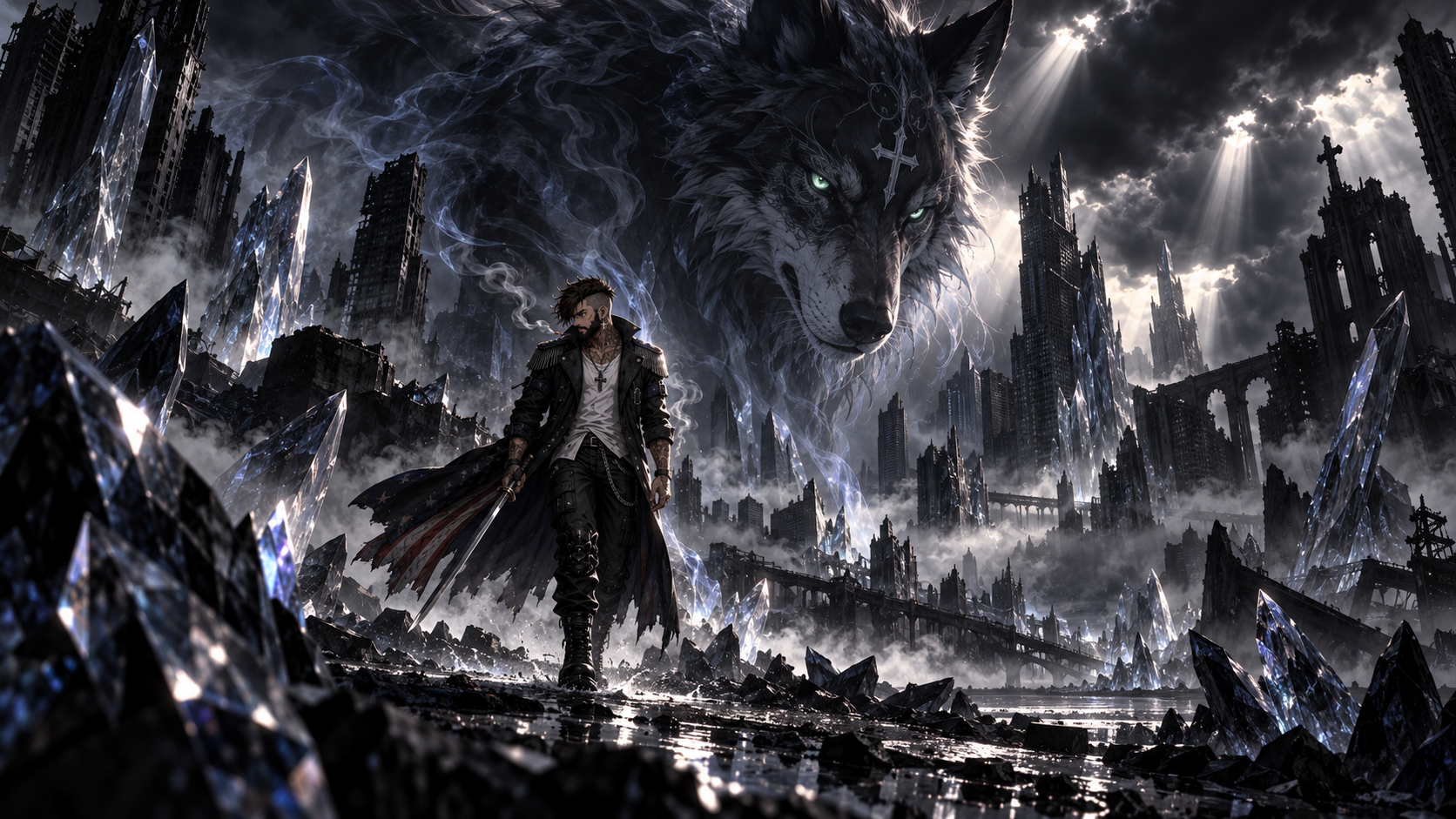
Walk through the crystal ruins of a dead civilization with a colossal spectral animal that reflects your character’s own identity. Species, markings, and atmosphere grow from the supplied character sheet.
GET THE PROMPT ↓THE FINISHED LOOK
01 EXAMPLEA solitary figure beneath a monumental spectral presence. This example shows a wolf; the prompt asks for an animal selected specifically for each character. Select the image to view the original at full size.
BEFORE YOU CREATE
START WITH YOUR CHARACTER SHEET.
- Attach one reference. Supply the character sheet that defines your character’s identity, outfit, and visual language.
- Copy the complete prompt. Paste it into your image generation chat with the sheet.
- Let the symbolism guide the species. The animal should reflect that specific character. The prompt discourages familiar fantasy defaults and limits the scene to one character and one spirit.
THE COMPLETE PROMPT
ORIGINAL TEMPLATECopy the complete prompt and supply your character sheet. The wording below is preserved, with paragraph breaks for readability.
Read the complete prompt
Create one epic cinematic 16:9 wide-angle environmental artwork using the supplied character reference sheet.

## CHARACTER IDENTITY

The supplied character sheet is the absolute authority for the character’s identity. Preserve their facial structure, apparent age, hairstyle, eye color, skin tone, body proportions, facial hair, tattoos, scars, markings, supernatural traits, clothing, footwear, jewelry, and accessories exactly as depicted.

Do not redesign the character, replace their outfit, or alter their established features. Adapt the walking pose naturally to their anatomy.

Use the sheet only as an identity reference. Do not reproduce its layout, labels, alternate views, or background.

Depict exactly one physical character in the finished scene.

## SPIRIT ANIMAL — UNIQUE SOUL MANIFESTATION

Behind the character, manifest one enormous spectral animal uniquely selected for this specific character.

### SPECIES SELECTION — CRITICAL

Do not default to a wolf.

Do not automatically choose a wolf, raven, lion, tiger, bear, or another commonly used fantasy spirit animal simply because it looks dramatic.

Before determining the spirit animal, visually interpret the supplied character sheet as if identifying that character’s personal symbolic creature.

Base the species on the specific combination of traits visible in this particular character:

- silhouette and body language
- apparent temperament
- clothing style and visual archetype
- supernatural traits
- tattoos, scars, symbols, or markings
- weapons or equipment
- color palette
- apparent fighting style
- elegance versus brutality
- speed versus physical power
- cunning versus directness
- social versus solitary energy
- grounded versus mystical presence
- predatory, defensive, scavenging, watchful, elusive, regal, strange, resilient, or other behavioral qualities

The goal is character-specific symbolism, not generic fantasy symbolism.

The spirit animal should feel like the answer to the question:

**“If this exact character’s soul naturally took the form of an animal, what animal would it become?”**

### SPECIES DIVERSITY

Consider the full animal kingdom, including unexpected or less commonly used species.

Possible categories include, but are not limited to:

big cats, small wild cats, bears, mustelids, foxes, coyotes, hyenas, jackals, wild dogs, deer, elk, moose, antelope, bison, boar, horses, goats, rams, reptiles, serpents, crocodilians, lizards, amphibians, sharks, rays, whales, orcas, deep-sea creatures, cephalopods, insects, arachnids, bats, rodents, primates, birds of prey, owls, corvids, vultures, cranes, herons, peacocks, game birds, and other unusual wildlife.

Rare, strange, elegant, intimidating, beautiful, unsettling, or unconventional animals are encouraged whenever they better represent the character.

Examples of valid character-to-animal reasoning might produce:

a calculating character → praying mantis

an elegant but dangerous character → secretary bird

a heavily armored unstoppable character → rhinoceros

a patient ambush-oriented character → crocodile

an eerie nocturnal character → owl or bat

an adaptable trickster → fox

a vicious opportunist → hyena

a proud duelist → crane

a mysterious aquatic or otherworldly character → manta ray

a deeply alien or intellectually dangerous character → octopus

a stubborn frontline fighter → boar

a highly defensive character → pangolin

a quiet but lethal character → snow leopard

a relentless survivor → wolverine

a character associated with transformation → moth

a commanding, watchful character → eagle

a deceptive or hypnotic character → serpent

These are examples of the range of possibilities only.

Do not automatically select any animal mentioned in these examples.

### WOLF RESTRICTION

A wolf is permitted only when the supplied character genuinely has unusually strong wolf-like symbolism or characteristics.

Being dark, brooding, male, battle-worn, solitary, protective, intimidating, mysterious, violent, or dressed in black is not sufficient justification for choosing a wolf.

Do not use “lone wolf” logic simply because the character is traveling alone.

If another animal provides a more distinctive symbolic match, always choose that animal instead.

Favor the most character-specific and visually interesting choice over the most familiar or conventionally heroic choice.

### NO SPECIES HYBRIDS BY DEFAULT

Choose one recognizable real-world animal species as the foundation.

Do not casually combine wolf + raven + dragon or create a generic fantasy chimera.

The uniqueness should come primarily from the choice of species and its supernatural interpretation, not from randomly combining animals.

Only use a mythical or hybrid creature if the supplied character sheet itself contains strong supernatural traits that clearly justify one.

### VISUAL CONNECTION TO THE CHARACTER

Once the species has been selected, transform it into a supernatural reflection of the character.

Subtly translate recognizable elements from the character sheet into the spirit animal:

- echo the character’s established eye color in its luminous eyes
- inherit restrained tones from the character’s signature color palette
- reinterpret tattoos, scars, supernatural markings, insignia, symbols, or recurring motifs as spectral patterns across fur, feathers, scales, skin, shell, wings, or other anatomy
- allow shapes from the character’s armor, clothing silhouette, weapons, or accessories to subtly influence the animal’s spectral contours without literally dressing the creature
- reflect the character’s personality through the creature’s posture, movement, expression, and gaze

Do not give the animal a human face.

Do not dress it in the character’s clothing.

Do not simply place the character’s logo or symbol on the animal’s forehead.

The resemblance should feel symbolic, subconscious, and organic.

## SCALE AND PRESENCE

The spirit animal towers behind the character at monumental scale, several times larger than the physical figure.

It occupies the upper midground and background without completely obscuring the landscape.

It should be immediately identifiable as the selected species even while partially obscured by fog and supernatural energy.

Preserve its characteristic real-world anatomy.

Its head, eyes, major body structure, posture, and defining species traits should remain clearly readable.

The outer edges of its body may dissolve into translucent supernatural energy, drifting mist, particulate light, smoke, dust, or luminous atmospheric matter.

Its body should feel partially present and partially incorporeal.

The spirit animal silently accompanies the character like an extension of their soul.

It may appear protective, observant, ominous, predatory, mournful, regal, curious, patient, furious, serene, alien, or unsettling depending entirely on the character.

Do not force the same emotional demeanor onto every spirit animal.

## CHARACTER–SPIRIT RELATIONSHIP

The character remains unaware of, quietly accustomed to, or spiritually synchronized with the immense presence behind them.

Their walking posture remains weary, resolved, and contemplative.

The colossal apparition reveals something about the character’s inner nature that their physical appearance alone cannot.

The animal should make the viewer instinctively think:

**“Of course that would be their spirit animal.”**

Visually align the character and spirit animal so that their silhouettes feel connected without merging their anatomy.

A restrained trail of matching supernatural energy may rise from around the character’s feet, shoulders, back, clothing, or silhouette and gradually expand into the spirit animal behind them, subtly implying that the apparition originates from the character.

Keep this connection elegant and atmospheric.

Do not create a giant glowing energy beam between them.

Depict exactly one spirit animal.

No animal pack.

No secondary animals.

No duplicate spirits.

No generic wolf silhouette added in the distance.

## SCENE

A dark, breathtaking crystalline wasteland after the end of civilization—sheer beauty in the face of total death.

Vast fields of translucent mineral spires emerge through shattered streets.

Hollow skyscrapers, broken towers, and collapsed buildings loom through dense atmospheric haze.

Monumental crystal formations pierce the dead architecture.

Fractured pavement, blackened rubble, mineral dust, and shallow pools of dark water cover the ground.

Low fog gathers between the crystals and drifts through the ruins.

No crowds, vegetation, or signs of thriving life.

The world feels abandoned, cold, ancient, and impossibly quiet.

## CHARACTER PLACEMENT

The character walks alone through the wasteland in a natural mid-stride pose, shown in three-quarter side view with enough of their face visible to remain recognizable.

Their full body occupies approximately one fifth to one quarter of the image height, emphasizing the immense landscape and colossal spirit animal.

Loose clothing, hair, coats, fabric, straps, and hanging accessories move gently in the wind, consistent with the reference sheet.

Their posture conveys weary resolve, quiet contemplation, and determination.

Preserve their silhouette against a restrained patch of illuminated mist.

The physical character must remain the primary narrative focal point even though the spirit animal is physically much larger.

The spirit should enhance the character rather than visually replacing them.

## CAMERA AND COMPOSITION

Use a low camera positioned close to large, sharply faceted foreground crystals.

Create an expansive cinematic wide-angle perspective with strong depth.

Foreground crystals sit mostly in deep shadow and frame the composition.

The walking character occupies the midground.

The gigantic spirit animal rises immediately behind and above the character, partially emerging from mist and atmospheric darkness.

Enormous crystalline formations and ruined buildings continue behind both figures and recede into layered darkness and fog.

Compose the character and spirit animal as one unified visual relationship:

small mortal figure below,

colossal spectral manifestation above,

dead civilization surrounding them.

Do not allow the spirit animal to fill the entire frame.

Preserve substantial negative space, ruins, crystalline geography, visible sky, and distant architecture so the scale of the world remains immense.

Keep the composition spacious, lonely, and imposing.

Use broad areas of darkness to create visual weight.

Selective light should guide the eye toward the physical character first, then the spirit animal’s face and eyes, then the distant ruins.

## LIGHTING — HIGH CONTRAST AND GOD RAYS

A thick, nearly black storm ceiling blocks most ambient light.

Through a few narrow breaks in the clouds, powerful shafts of cold white light descend into the wasteland.

These god rays are clearly defined by suspended dust, mineral particles, and mist, creating dramatic diagonal columns across the ruined city.

Use strong chiaroscuro:

deep near-black shadows,

restrained midtones,

concentrated luminous highlights.

Most of the environment remains dark.

Only isolated sections of crystal, broken architecture, drifting fog, the character, and portions of the spirit animal catch the light.

One shaft passes behind or close to the character, producing a thin rim of illumination along their silhouette and a small illuminated section of their path.

Another portion of atmospheric light may pass through the translucent spirit animal, revealing layers within its spectral body.

The spirit animal must interact naturally with the scene’s lighting.

God rays passing through its translucent body may scatter, refract, diffuse, or become partially interrupted by denser supernatural forms.

Its internal glow must remain secondary to the environmental lighting rather than turning the entire scene into a bright neon composition.

Keep facial illumination on the physical character subtle and believable.

God rays must feel volumetric and grounded in the atmosphere, with visible shadow gaps, soft scattering, and natural falloff.

Preserve the surrounding darkness.

Avoid evenly lighting the scene.

Do not fill the entire sky with glow.

## SPIRIT ENERGY AND ATMOSPHERIC INTERACTION

The spirit animal produces a subtle supernatural aura derived from the character’s established palette.

Its energy spills softly into the surrounding mist without overpowering the composition.

The aura mingles with the natural god rays, producing occasional luminous edges and volumetric intersections around the animal’s head, shoulders, wings, horns, limbs, tail, or other defining anatomy depending on the chosen species.

Nearby fog bends and flows around the enormous spectral mass.

Small suspended particles may drift through the apparition and become temporarily illuminated inside it.

Energy density should vary naturally across the animal’s form.

Some areas appear almost physically solid.

Others become transparent.

Others disappear completely into fog.

The supernatural effect should feel sacred, haunting, ancient, and immense rather than explosive or flashy.

## CRYSTALS AND REFLECTIONS

Crystals appear cold, translucent, and partly smoky, with dark interiors, precise facets, and occasional razor-thin highlights.

Only crystals touched by god rays or faint spirit energy refract light strongly.

Use restrained spectral glints and faint internal scattering.

The formations should feel like real mineral structures illuminated by external light.

The crystals closest to the camera carry subtle, fragmented reflections of the walking character, ruined skyline, distant lights, and occasional abstract fragments of the spirit animal’s glow.

Reflections must follow individual facet angles and remain partial, distorted, faint, and physically believable.

Do not create recognizable duplicate spirit animals inside the crystals.

No duplicate characters.

No floating faces.

No prominent reflected portraits.

No images or figures visibly trapped inside the crystals.

## COLOR PALETTE

Use charcoal black, slate gray, desaturated midnight blue, muted violet, cold silver, and restrained mineral tones.

Preserve the character’s established colors while allowing the gloomy environmental lighting to naturally mute them.

Allow the spirit animal’s supernatural accents to inherit restrained colors from the supplied character sheet, especially the character’s eye color, supernatural energy, and signature visual motifs.

Reserve the brightest values for:

- god rays
- the spirit animal’s eyes
- a few spectral edges
- selected crystal facets
- subtle character rim lighting
- selective reflections on wet ground

Avoid golden sunset lighting.

Avoid cheerful saturation.

Avoid rainbow crystal fields.

Avoid generic bright-blue ghost effects unless directly supported by the character sheet.

Avoid excessive neon.

Avoid excessive bloom.

## MOOD

A haunting apocalyptic wonderland.

Oppressive.

Mournful.

Mythic.

Lonely.

Sacred.

Awe-inspiring.

Beauty survives in the mineral stillness of a dead world.

The solitary character feels physically insignificant against the ruined civilization, yet the colossal spirit behind them reveals the immense force hidden within.

The ruins should feel monumental.

The darkness should feel consuming.

The spirit animal should feel personal, ancient, and almost divine.

The rare light should feel sacred.

## STYLE

Premium semi-realistic anime cinematic key visual.

Precise linework.

Bold high-contrast cel shading.

Richly rendered environmental lighting.

Convincing crystal materials.

Accurate and recognizable animal anatomy.

Expressive spectral effects.

Layered atmospheric perspective.

Strong cinematic depth.

Subtle environmental reflections.

Highly detailed foreground elements with progressively softer detail toward the distant ruins.

Maintain a mature dark-fantasy aesthetic rather than a cute, cartoonish, or mascot-like interpretation.

The spirit animal should look majestic and believable within the same visual world as the character.

No text.

No titles.

No labels.

No reference-sheet panels.

No character-sheet layout.

No duplicate characters.

No additional spirit animals.

No animal pack.

No generic background wolf.

No watermark.