IMAGE CREATION / SYMBOLIC PORTRAIT
THE CHILD
WITHIN.
You became the person your younger self needed.
Create a symbolic portrait of the same character at two ages: a monumental adult silhouette sheltering their younger self within a warm light at the center of their chest.
GET THE PROMPT ↓THE FINISHED LOOK
02 EXAMPLESOne presentation, two distinct characters. Select an image to view the original at full size.
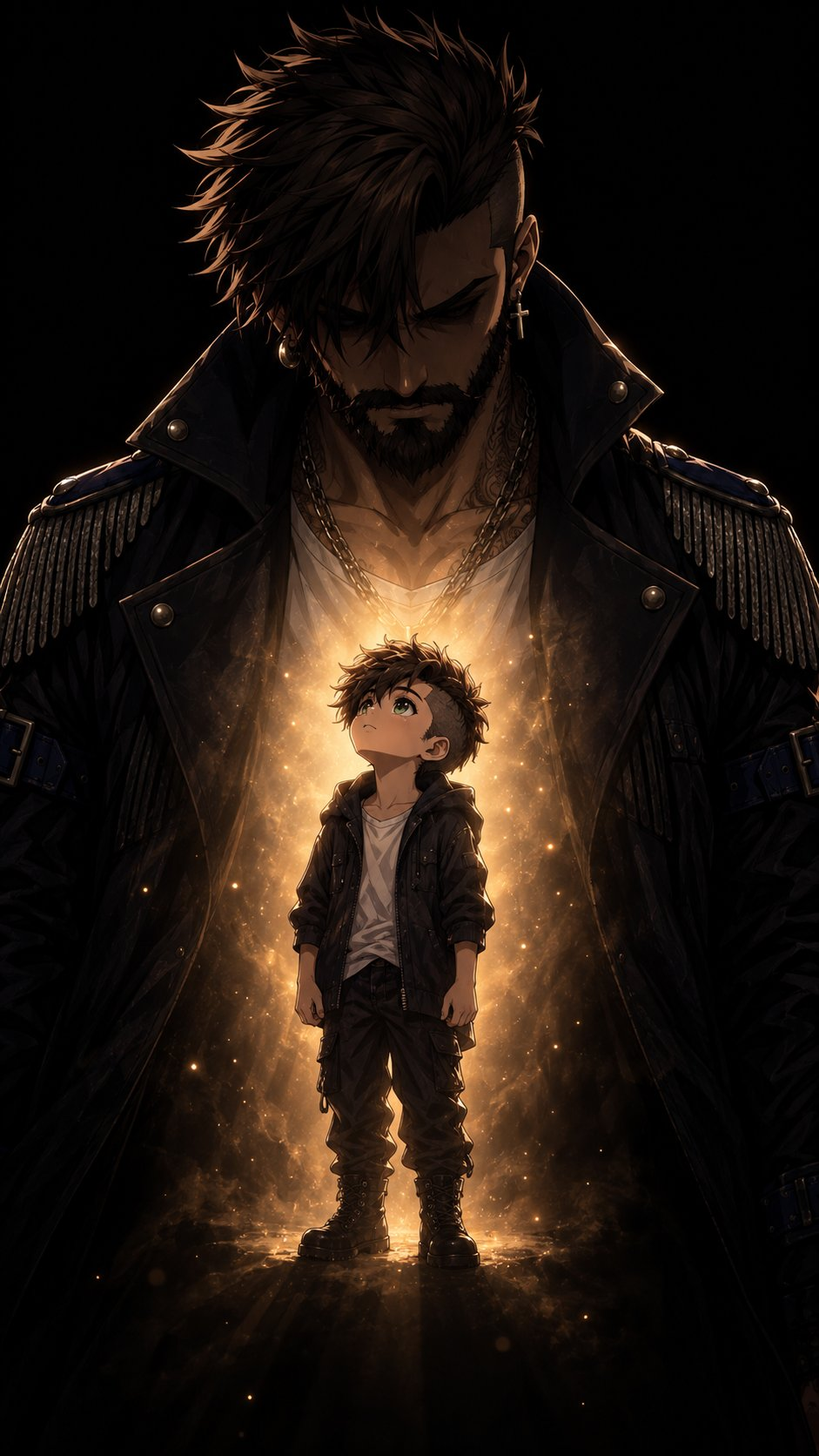
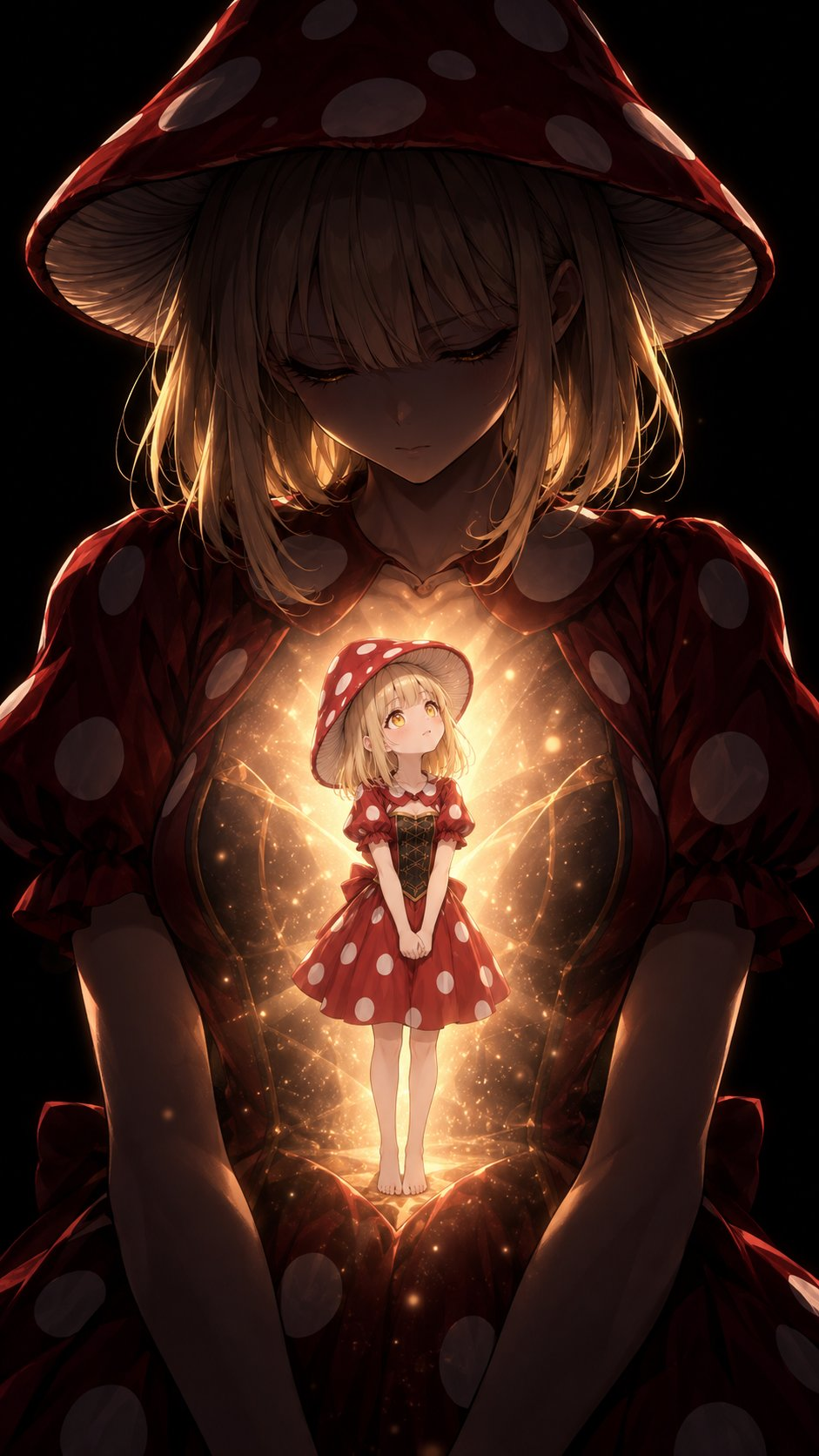
BEFORE YOU CREATE
ONE CHARACTER. TWO SELVES.
- Attach your character sheet. Supply the reference that defines the character's face, clothing, markings, and accessories.
- Copy the complete prompt. The prompt defines the adult silhouette, the younger self, and the central light. One character sheet supplies the identity for both ages.
- Create the portrait. Paste the prompt with your character sheet into your image generation chat. Childhood traits should remain age appropriate, while the adult keeps their established design.
THE COMPLETE PROMPT
ORIGINAL TEMPLATEThe full original prompt, ready to use with your character sheet.
Read the complete prompt
Create one emotionally powerful, symbolic cinematic illustration representing the inner child looking up toward the person they eventually became.

FORMAT AND STYLE

* Aspect ratio: 9:16 vertical
* Art style: dark cinematic, high-contrast, semi-realistic anime
* Rendering style: heavy cel shading, bold shadow shapes, dramatic lighting, refined anatomy, painterly atmosphere, emotionally intense composition
* Mood: intimate, haunting, solemn, reflective, bittersweet, quietly hopeful

The final image should feel like a polished, premium anime key visual with strong emotional storytelling.

⸻

CHARACTER REFERENCE

Use the supplied character sheet as the absolute visual authority for the character’s identity.

The same character must appear in two forms within the same composition:

1. The present-day adult, shown primarily as a large waist-up silhouette
2. The childhood version, shown as a small full-body child standing within the illuminated center of the adult’s chest

The child must clearly read as a believable younger version of the same exact character.

Preserve and appropriately translate all established identifying traits from the character sheet, including:

* facial structure
* skin tone / natural coloration
* species
* eye color
* eye shape
* hair color
* secondary hair colors or streaks
* hairstyle characteristics that could plausibly exist in childhood
* hair texture
* ears
* horns, antlers, wings, tails, or other nonhuman anatomy
* markings
* freckles
* birthmarks
* scars that would logically already exist at that age
* natural physical features
* identity-defining accessories when age-appropriate

Do not redesign the character.

Do not turn the child into a random generic child.

The viewer should immediately understand that the child and adult are the same person at different ages.

Do not automatically give the child adult-only traits such as facial hair, mature musculature, adult tattoos, or later-life scars unless those traits would logically already exist.

⸻

COMPOSITION

Use a pure black or near-black background with no distracting environment.

The adult character should dominate the image.

Show the adult from approximately the waist up, centered in the composition, facing mostly forward.

The adult should read as an enormous, imposing silhouette emerging from darkness.

The silhouette should remain primarily dark, but subtle edge definition should preserve recognizable elements such as:

* hairstyle silhouette
* head shape
* shoulders
* signature outfit silhouette
* ears
* horns
* wings
* tail base if visible
* other major anatomy

The adult’s face should be mostly hidden in shadow.

Only the faintest traces of structure should be visible where the inner chest light softly reaches upward.

The adult should feel monumental in scale compared to the child.

The overall composition should be clean, iconic, and centered, taking full advantage of the 9:16 vertical space.

The adult’s head should occupy the upper portion of the frame, the glowing chest should sit near the visual center, and the child should stand within that glow.

⸻

THE LIGHT WITHIN

At the exact center of the adult’s chest is a soft but powerful internal light.

This glow must feel like it comes from inside the adult, not from an outside light source.

The chest should feel like it contains an emotional core.

The light should be:

* warm
* soft
* luminous
* ethereal
* comforting
* symbolic
* brightest at the center
* fading gradually into shadow

Use:

* atmospheric glow
* soft bloom
* floating dust motes
* light haze
* subtle volumetric rays
* controlled diffusion

Do not depict a literal anatomical heart.

This is symbolic emotional light.

The glow should suggest that something innocent, vulnerable, and deeply personal still exists inside the adult self.

⸻

THE CHILD

Inside the glowing center of the adult’s chest stands the child version of the character.

The child should appear roughly 6 to 10 years old, unless another age is specifically implied by the character context.

Show the child as a small but clearly visible full-body figure.

The child should stand inside the illuminated chest space, surrounded by warm light and darkness beyond.

The child must be facing upward toward the adult’s face.

Their head should be tilted up.

Their eyes should be directed toward the adult silhouette above them.

The child’s expression and posture should communicate a mixture of:

* wonder
* vulnerability
* quiet recognition
* uncertainty
* admiration
* hope

Keep the emotion subtle and sincere.

Avoid exaggerated crying, melodrama, or cartoonish sadness.

The pose should feel natural, such as:

* arms resting at their sides
* hands loosely clasped
* one hand slightly lifted
* a still, quiet stance

The child should feel small, emotionally exposed, and safe within the adult form.

⸻

RELATIONSHIP BETWEEN THE TWO SELVES

The adult is not threatening the child.

The image symbolizes:

the younger self looking up at the person they survived long enough to become.

The adult silhouette should feel:

* solemn
* protective
* powerful
* weathered
* quietly compassionate
* emotionally distant on the surface, but deeply connected within

The child should feel sheltered inside the adult.

There should be a clear emotional connection between the two figures, even though they are not touching.

The adult’s head may angle slightly downward, just enough to imply silent acknowledgment.

Keep this symbolic rather than literal.

This should feel like an inward emotional moment, not a physical scene in a real place.

⸻

LIGHTING

Use dramatic cinematic lighting with very deep blacks and a strong central glow.

The chest light is the main light source.

It should illuminate:

* the child’s face
* the child’s hair
* the child’s clothing
* the interior contours of the adult silhouette
* subtle edges of the adult’s jaw, neck, chest, shoulders, and clothing nearest the glow

Everything farther away should disappear into deep shadow.

Do not brighten the whole adult.

Preserve the silhouette.

A very faint rim light may outline the adult from the background, but it must stay secondary.

The image should feel high contrast, with bold separation between light and shadow.

Use heavy cel shading with crisp shadow shapes, dark masses, and selective soft atmospheric transitions only where needed for glow and mood.

⸻

VISUAL SYMBOLISM

The adult represents:

* survival
* experience
* endurance
* scars
* maturity
* strength
* responsibility
* the weight of everything life has added

The child represents:

* innocence
* vulnerability
* memory
* early fear
* early hope
* the self that still lives underneath everything else

The glowing chest represents the emotional core where that child still exists.

The surrounding darkness represents the emotional weight, pain, distance, and complexity accumulated through life.

Keep the symbolism visual.

Do not include captions, labels, or text in the image.

⸻

ART DIRECTION

Render the piece in a dark cinematic semi-realistic anime style with:

* heavy cel shading
* high contrast lighting
* bold shadow design
* refined anime facial structure
* believable anatomy
* dramatic proportions
* painterly atmosphere
* strong silhouette readability
* subtle texture
* premium illustration quality
* emotional visual storytelling

The piece should feel polished and intentional, like a dramatic anime poster or cover illustration.

Avoid:

* photorealism
* generic fantasy effects
* random glowing symbols
* literal hearts
* unnecessary background scenery
* extra characters
* duplicate adults
* duplicate children
* horror distortion
* threatening body language
* soft pastel lighting
* low-contrast rendering
* overly bright environments

⸻

EMOTIONAL TARGET

The final image should evoke the feeling:

“You became the person your younger self needed.”

Do not place that sentence, or any other text, inside the image.

The emotional power should come entirely from:

* scale
* lighting
* posture
* silhouette
* facial direction
* visual contrast
* the child’s upward gaze
* the quiet protective presence of the adult self

The final result should feel deeply personal, symbolic, dark, cinematic, and emotionally moving.